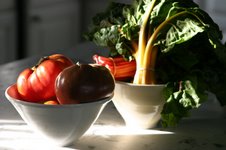
The second bunch of lacinato was begging to be dispatched tonight, so I heated some olive oil, tossed in three cloves of garlic, sliced up, an inch and a half piece of fresh ginger, peeled and cut into matchsticks, and then the kale, sliced into ribbons. I let it sizzle for a minute then added 3/4 cup of chicken stock and let it cook down, stirring it occasionally. When the liquid had reduced somewhat, I added a teaspoon of black bean chili paste, a recent and accidental discovery. I let it cook nearly dry, so that some of the kale was almost crispy.
This was a side dish for some chicken thighs poached in my treasured poaching liquid from this recipe (yep, Bittman again.) I've made this three times with whole chickens, and tonight with some frozen and defrosted thighs. They simmered in the hot sauce for ten minutes and then I turned off the heat and let them sit for another ten minutes or so before serving. I sliced the chicken and served it and the greens atop my staple rice (short grain brown rice with turmeric and ginger: take 1 T olive oil, heat in a heavy pot, add 2 c. organic short grain brown rice and begin to saute; add 2 T. ground turmeric and a 2 inch piece of fresh ginger, peeled and cut into four chunks; after sauteing on medium heat about four or five minutes, add four cups of chicken or vegetable stock, or plain water, and salt to taste (usually, for me, 1 1/2 t. celtic sea salt) and bring to a boil. Once it boils, turn the heat way down, as low as it will go, and simmer until the liquid is absorbed, usually about an hour. This stuff is delicious; I eat it twice a day and don't get tired of it. Maybe that says more about me than about the rice; judge for yourselves.)
Monday, May 19, 2008


Sunday, May 18, 2008
Loca-sort of
Dinner party conversation last night was about growing things (the search for a true red geranium) and also about the lack of things grown--the farmer's market pickings are still slim, as we are barely, barely into spring here in near-New England. I did make it to the Lenox market on Friday, and mostly bought plants--herbs and some lacinato kale which I will set out in a week or two. We bought some cider, too, no doubt from stored apples. Fine, but not exactly a sign of things to come.
I did manage to find some fiddleheads at the healthfood store this week, though, and so I decided to experiment with them. (For those who don't know, fiddleheads are fern shoots, tightly coiled baby leaves forming circles about an inch across, shaped like the head of a violin. Along with morels and asparagus, they are a classic first-of-spring delicacy, but one I'd never eaten or cooked.) I first blanched them, then briefly sauteed them in good olive oil with salt and pepper; I served them as part of a salad (they were still warm when I tossed it all together) with pea shoots and goat cheese (both local) and a vinaigrette with champagne vinegar, shallots and more good olive oil. (So much for that locavore thing.) It was good, but the fiddleheads overwhelmed the pea shoots, and the whole thing needed a punch--I think pomegranate seeds would have been a welcome addition. (Again, just kick that whole 100 mile idea to the curb.)
My main course, chicken breasts with a kale stuffing, came from Mark Bittman's Bitten blog, a source of many great meals over the last few months. I adapted his dish, changing his spinach for kale (a California-grown lacinato like the one I plan to plant) and using currants instead of golden raisins, because that's what I had in the pantry. I also added a little chicken stock and cooked the stuffing a bit longer, since the kale is tougher and slower to soften than the spinach. The result was truly delicious, served with brown rice cooked with cumin and ginger, a staple of my diet these days (and another challenge to eating locally.)
Tuesday, May 13, 2008
It's almost time...
I have six heirloom tomato seedlings on my kitchen sill, and six enormous boxes containing these down by the barn. The sages say that Memorial Day is when it's safe to put those babies in the ground, so we're close. Meanwhile, my plans for an asparagus patch have been foiled by (yet another) spring running under our ground. I didn't know I needed to have a dowser around to dig a bed, but then again, there's a lot I don't know.
Stay tuned for a Farmer's Market report on Friday.
Stay tuned for a Farmer's Market report on Friday.
Sunday, May 11, 2008
The season is upon us (me)
A local online paper announced that it's farmer's market season, so I have no excuse to postpone reentering this little blog experiment. Never mind that I missed all the markets this weekend, I have bountiful adventures to share nonetheless. As I dig (forgive the pun) further and further into the experience of growing things, this blog seems like the better place to explore them. So this summer, with any luck, I'll chronicle not only my semi-locavore eating, but also the growing of food (or at least the attempt.)
Yesterday I attended an organic gardening and sustainable farming workshop at the lovely Hancock Shaker Village. If you ever find yourselves in the Berkshires or my little corner of New York, this place is a must see. Not only is the Shaker heritage incredibly important to this part of the world, a look backward at the Shakers' sustainable and logical methods of living and production is ever-more relevant. All day long, I kept feeling that someday soon, the world is going to turn to these experts to help us figure out how to survive, to eat.
The class yesterday was taught by the master gardener and master farmer of HSV, two passionate, funny guys with more wisdom and experience to share than their relative youth might have suggested. We covered everything from vermiculture to drying seeds; I took five pages of notes, received twenty more pages of handouts, not to mention a gigantic bag of compost and well over a dozen plants.
An auspicious beginning to what I hope will be a bountiful season.
Wednesday, July 18, 2007
Restaurant rave--Route 7 Grill/Great Barrington, Massachusetts
The Route 7 Grill in Great Barrington was quite literally the very first new restaurant I tried in our area after my husband and I committed to moving here (i.e., after we bought our house, about the biggest commitment I am prepared to make to anything or anyone.) When my son and I flew out here together, without his dad or sister, to look at schools and close on the house, I took him there for dinner our first night. It was early March and a little blustery, and Route 7's warm fireplace and earnest comfort food hit the spot for us both. We've been going back ever since for the pulled pork, burgers (my son's favorite--he's six, after all), fries, daily greens, ribs and pretty much everything else on the menu, too.
I have only one quibble, with the biscuits and the cornbread, which should be better than they are: the cornbread is too sweet, and the biscuits too dense. Being almost southern*, I have particular opinions about such things--sugary cornbread is an abomination, and I expect restaurant biscuits to be at least as good as the ones I make at home with only White Lily flour, sweet butter and milk.
Make that two quibbles, the second also routed in my southern quasi-heritage: the pulled pork is dying for a real North Carolina-style vinegar and hot pepper sauce. But it's good as served, with a sauce that feels more Memphis or Texas in its inspiration, sweet and tomato-ey, mercifully not catsup-y or too thick.
Picayune complaining aside, Route 7 is a delicious, dependable restaurant that gets extra credit for serving nearly all locally-sourced ingredients. They make a point of using meat and vegetables produced within Berkshire and Columbia counties, and now their receiving some big time recognition for their slow food efforts. Today's Boston Globe featured this great review/article--read it, and check out Route 7.
*I lived in Tennessee as a child and in North Carolina for bits and pieces of my college years, but alas, born in Chicago, I will forever be labeled a Yankee.
Saturday, July 14, 2007
Cucumbers and radishes and squash, oh my
This week's bounty (sorry, no picture--it was hurled into the house yesterday as I rushed around to make dinner for us and guests) is so heavy on cukes, summer squash and daikon that I am contemplating an adventure in pickling. My son, who prior to our "You wanna make pickles?" conversation in the car yesterday never realized that "sweet" is a pickle category (he loves him some Kosher dills, though) is having visions of sugar dancing in his head, but I'm a little leery. I'll be breaking out my 1948 Kerr's Canning cookbook tomorrow for inspiration. Stay tuned.
Meanwhile, the list:
10 cukes
10 summer squash (including some pattypan)
one head of redleaf lettuce
one head of Chinese cabbage
one bunch of daikon (three big ones)
parsley
one bunch of turnips
Like I said, heavy on the squash, too. Maybe I can pickle that as well? A childhood summer of too many giant zucchinis makes the sight of my produce drawer overflowing, literally, with last week's squash and this week's too, a little nauseating. I'm thinking a gratin might be in order.
Sunday, July 8, 2007
Hide the veggies
My children, aged 2 and nearly 6, are confirmed vegephobes. No amount of enthusiastic discussion of the provenance of green things, nor age-blind inclusion in their preparation, will entice either of my kids to eat much more than a single bite of (only) broccoli or carrot. Every odd moment, a piece of lettuce crosses one or the other's lips, but that's it.
So I find myself concocting ways to camouflage grown things in acceptable disguises. My turkey meatloaf is always a big hit, and the chopped zucchini and carrots folded into it have never deterred either child. (Not true, by the way, of the onions I add to my black beans--never again will I commit the sin of coarsely chopping them.)
These meatballs are similar to my meatloaf, but designed to use up some of the bounty from this week and weeks past. Serve them with any pasta, or alone, or atop other steamed vegetables (great for adults) or in a sandwich.
Meatballs in Tomato Sauce
serves 4
1-1/2 lbs. ground beef, turkey, pork, veal or combination thereof
2 eggs
1-1/2 c. fresh breadcrumbs
1 t. Maldon salt
1/2 freshly ground pepper
1-1/2 c. minced fresh spinach
1 T olive oil
1 can crushed San Marzano tomatoes
2 cloves garlic, minced
1 zucchini, cut into 1/4 inch or smaller dice
2 carrots, cut into 1/4 inch or smaller dice
2 T tomato paste (optional)
2 T agave syrup or sugar to taste
Combine ground meat, breadcrumbs, eggs, spinach, salt and pepper in a bowl and mix thoroughly--best is to just use your hands.
Form into meatballs about 1-1/2 inches in diameter. You should have about two dozen.
Heat the olive oil for a minute over medium heat in a skillet and add as many meatballs as can comfortably fit in one layer. (You may have to do this in two batches. Don't let that deter you.)
Brown the meatballs on all sides. For kids, in particular, it's ok to let them get crunch on the outside. When they're browned and just cooked through, remove to a plate. When all the meatballs are cooked, begin the sauce.
Return the skillet to medium heat and add the garlic. Stir for a couple of minutes until it begins to brown, and add the zucchini and carrots. Continue sauteing until the vegetables begin to soften--around eight minutes. Add the canned tomatoes, and cook at a nice simmer for ten or so minutes. Meanwhile, put water on to boil for pasta, if you're making it. Stir the tomato paste and agave or sugar to taste into the sauce. Continue cooking as long as you like--as with most tomato sauces, short of burning the stuff to the pan, it's pretty impossible to overcook. But you can also serve it as soon as your pasta is done cooking. Just add the meatballs back to the skillet and reheat for ten minutes or so.
Serve as desired atop pasta, veggies, solo or in a sandwich.
Subscribe to:
Posts (Atom)